Self-Awareness
Principle 007 The Voice Is Borrowed
The voice inside your head feels personal because it has been with you for so long. Familiarity is mistaken for identity. The question is not what the voice is saying. The question is who taught it to speak.
The voice inside your mind feels like identity because it has been repeated for so long. This principle explores how the unconscious builds an inner narrator from inherited conclusions, and why recognising it changes the way you read yourself.
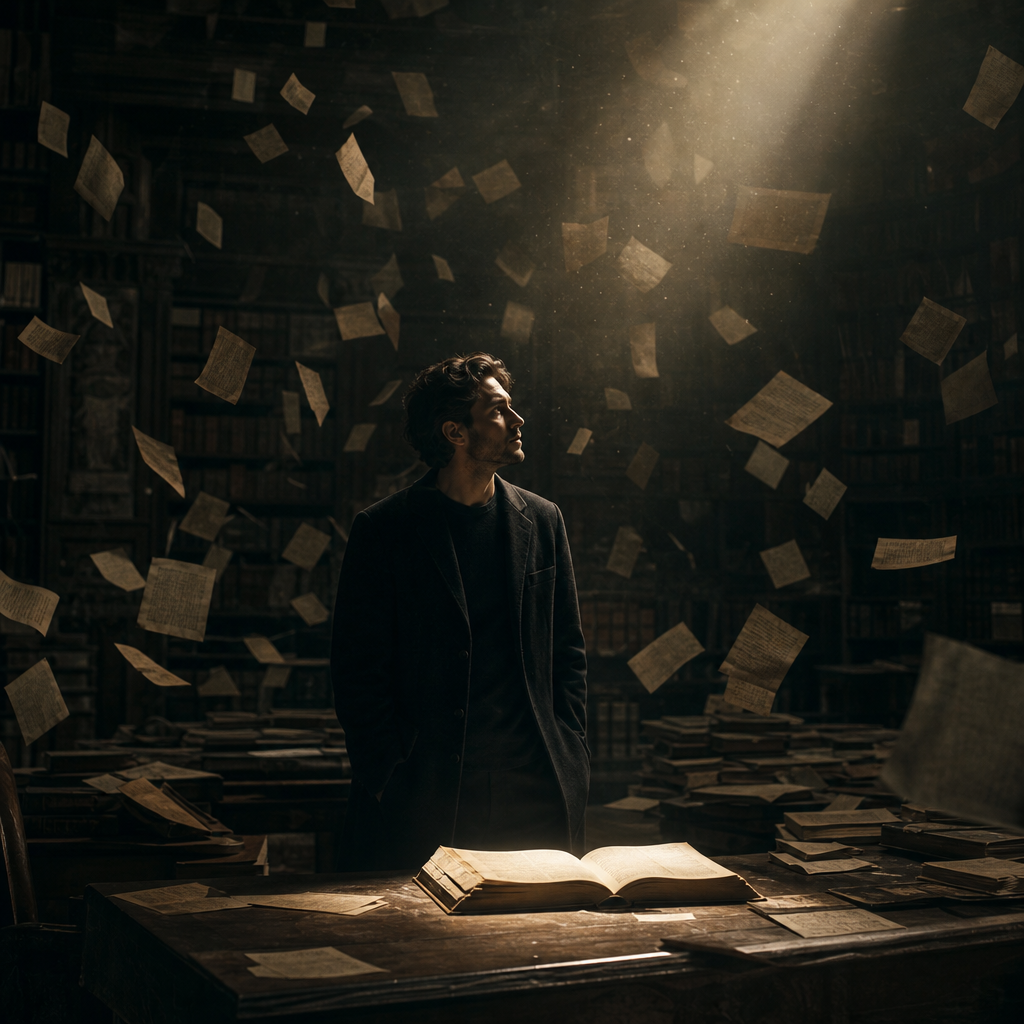
Most people believe they are listening to themselves.
The assumption feels so obvious that it is rarely questioned. Every thought appears in the first person, every judgement feels personal and every prediction carries the weight of certainty. The voice has accompanied every important moment of life, so familiarity becomes evidence of identity.
Yet the voice does something strange.
It speaks differently depending on who is in the room.
Around one person it becomes cautious, around another it becomes defensive, around someone you admire it begins comparing and around someone you fear it starts rehearsing explanations before you have spoken a single word.
The voice adapts to the audience while the listener remains strangely constant.
This raises a question - If the voice changes so easily, what exactly has remained the same?
Every Voice Is Built Before It Is Recognised
The voice did not arrive fully formed.
It was assembled long before you noticed it.
Children do not invent an identity, they absorb one. They learn which emotions are welcomed, which questions are ignored and which parts of themselves receive approval. Every repeated experience leaves behind more than a memory, it leaves behind a conclusion and those conclusions weave and connect until they become an invisible subconscious method of reading the world.
Years pass.
The moments of the original 'lessons' fade.
The conclusions remain.
Eventually the voice begins speaking with those conclusions so fluently that it no longer sounds borrowed, it sounds like personality. The phrases become so familiar that authorship disappears. Few people remember who first taught them the sentences they now repeat to themselves every day.
Repetition Creates Authority
The psyche has an unusual relationship with repetition.
An idea repeated often enough no longer feels like an idea, it feels like an observation and given enough time, an observation begins to feel like a fact. Repetition replaces evidence.
A person who has carried the sentence, "I disappoint people," for twenty years rarely notices themselves repeating it. They notice themselves finding proof of it when every difficult conversation strengthens the belief, every contradiction fades into the background because it does not belong to the existing Story.
The Pattern is never maintained by facts alone, it is constantly reinforced by selective attention. The Story learns to recognise itself wherever it looks.
The Present Is Read Through Yesterday
Most experiences are interpreted before they are experienced.
A delayed message already means rejection.
Silence already means disapproval.
Success already carries the expectation of failure.
Nothing in the present created those conclusions, the present merely provided another surface onto which an older Story could be projected. Experience becomes less about discovering what is happening and more about confirming what has already been decided.
This is why two people can live through the same event and carry away completely different realities.
They did not experience different events, but rather read the same event through different Stories.
The Voice Protects The Story
Identity depends upon continuity.
If the Story changes too quickly, the mind loses its sense of certainty. The familiar explanation begins to dissolve and something unexpected appears beneath it, confusion, possibility or freedom.
The psyche does not rush towards these experiences, it prefers explanations that have already proved capable of organising life, even when those explanations quietly produce the same disappointments again and again.
The voice exists to preserve coherence.
It links today's experience to yesterday's conclusions until they feel inseparable, over time the Story becomes so convincing that questioning it feels like questioning yourself. Second guessing.
Very few people realise they are defending a narrative rather than discovering the truth.
That misunderstanding is where the Pattern survives.
The Voice Is Not Trying To Discover The Truth
Most people assume the voice exists to understand reality, watch it closely and another pattern appears. It is remarkably uninterested in discovery.
Its first instinct is recognition.
The moment something happens, the voice searches for a familiar explanation. It reaches backwards rather than forwards, looking for an old conclusion that can organise the new experience, a safe reference point. The present is rarely allowed to arrive but is measured against everything that came before it.
This is why the same person can appear supportive one day and threatening the next without changing their behaviour. The Story changed first. The voice simply rearranged reality until it fitted.
The Narrator is not dishonest. It is loyal. The problem is that this loyalty belongs to continuity, and adherence to the safe reference point - which may sometimes require rewriting.
Every Story Needs Evidence
Once a Story becomes established, it begins recruiting.
Every disappointment is welcomed as another witness.
Every success is questioned until it can be safely explained away.
Someone who carries the Story, "I am never enough," will dismiss genuine praise as politeness while treating a single criticism as solid proof. Another person convinced that people cannot be trusted will overlook years of loyalty yet remember one betrayal with extraordinary clarity.
The Story is constantly selecting evidence that allows it to survive.
This is why Patterns become so persuasive.
The evidence is real. The selection is unconscious.
The Most Powerful Sentences Are Never Spoken Aloud
Hidden beneath every Story is a sentence that no longer sounds like language.
It sounds like reality.
"I have to earn love."
"My needs create problems."
"If I stop achieving, I disappear."
These sentences are rarely examined because they were accepted before they were understood. They settled beneath awareness and became the foundation upon which thousands of later thoughts were built. Every decision, relationship and fear organised itself around an agreement that consciousness no longer remembers making.
The sentence disappears......Its consequences remain.
Recognition Changes The Relationship
Psychological change begins in an unexpectedly small moment, the voice says something it has said a thousand times before.
However, for the first time, it is recognised instead of obeyed.
Nothing has changed about the sentence itself, it still appears with the same confidence, it still offers the same explanation. The difference is that it is no longer invisible.
A thought that can be recognised can also be questioned, a Story that can be questioned no longer has complete authority.
This is where The Reader first appears.
Not as another voice.
As the part of consciousness that notices the Story without immediately becoming it.
The Story continues speaking.
The Reader changes the relationship between the speaker and the listener.
That is enough.
Once the mechanism has been seen, the Pattern can never again pretend it is the whole truth.
The Reader Changes Everything
The most significant moment in psychological development is almost impossible to notice while it is happening.
Nothing dramatic occurs.
The voice does not disappear, the Story does not collapse, life continues exactly as it did the day before.
One small change takes place.
The sentence that has organised your experience for years is recognised as a sentence.
That distinction matters.
Before that moment, the voice describes reality. After that moment, the voice becomes one possible interpretation of reality.
The Pattern has not ended, its authority has weakened.
Every Pattern Begins With An Unquestioned Sentence
Behaviour grows from interpretation, and interpretation grows from the language through which experience is organised. Every recurring relationship, every familiar disappointment and every predictable emotional reaction can usually be traced back to a sentence that escaped examination because it arrived too early in life.
The sentence became invisible, its consequences did not, they had a lasting effect.
The Pattern was never living inside behaviour - It was living inside language.
This is why lasting psychological change rarely begins with new habits, it begins when an old sentence loses its claim to certainty. That realisation, recognisation and awareness that the Pattern became the voice.
Reading Your Own Mind
The voice is not an enemy. It is an archive.
Every warning it offers once served a purpose, every conclusion once helped organise experience, and every prediction once made the world feel more understandable than it really was.
The problem begins when yesterday continues reading today and the Story stops evolving.
The Pattern becomes self-maintaining.
The voice continues speaking with the confidence of someone who has never been introduced to new evidence.
The point is not always to improve the Story, so much as to discover how to read it. There is a profound difference between living inside a sentence and recognising that you have been living inside one.
The first creates identity.
The second creates freedom.
CONTINUE READING
Continue exploring the foundations of Personal Mythology.
Principle 001 The Pattern Comes First
Discover why repetition is the basic language of the psyche and why recurring experiences deserve closer attention.
Principle 002 The Life You Were Never Allowed To Live
Explore how adaptation shapes identity and why many of our lives begin as someone else's expectations.
Principle 003 The Pattern Will Continue Until You Read It
Understand why life keeps presenting the same situations until the underlying pattern becomes conscious.
Principle 004 The Psyche Always Seeks Balance
Learn how the unconscious continually compensates for what consciousness ignores.
Principle 005 What You Resist Does Not Disappear
Discover why resistance strengthens unconscious patterns until they are recognised.
Principle 006 You See Others Through Yourself
Explore why the people who affect you most often reveal hidden parts of your own psyche.
Journal prompts
- Choose a single sentence that has followed you for as long as you can remember.
- Do not choose the loudest one.
- Choose the one that feels most ordinary.
- The sentence that appears so naturally you almost overlook it.
- Write it down exactly as it speaks.
- Then ask a different question.
- If this sentence were removed from my mind tomorrow, what version of me would disappear with it?
- Do not answer immediately.
- Live with the question.
- The sentence you are most reluctant to examine is often the one that has been organising your life.
Begin Your Personal Mythology
Every life is organised by a Story. Most people never realise they are living inside one. Your dreams, patterns and recurring experiences reveal the sentences that have shaped your identity for years. Read the Story. Discover the Pattern. Begin your Personal Mythology.
Begin Your Personal MythologyI post the short version of these on Instagram most days. Follow @mythradar on Instagram