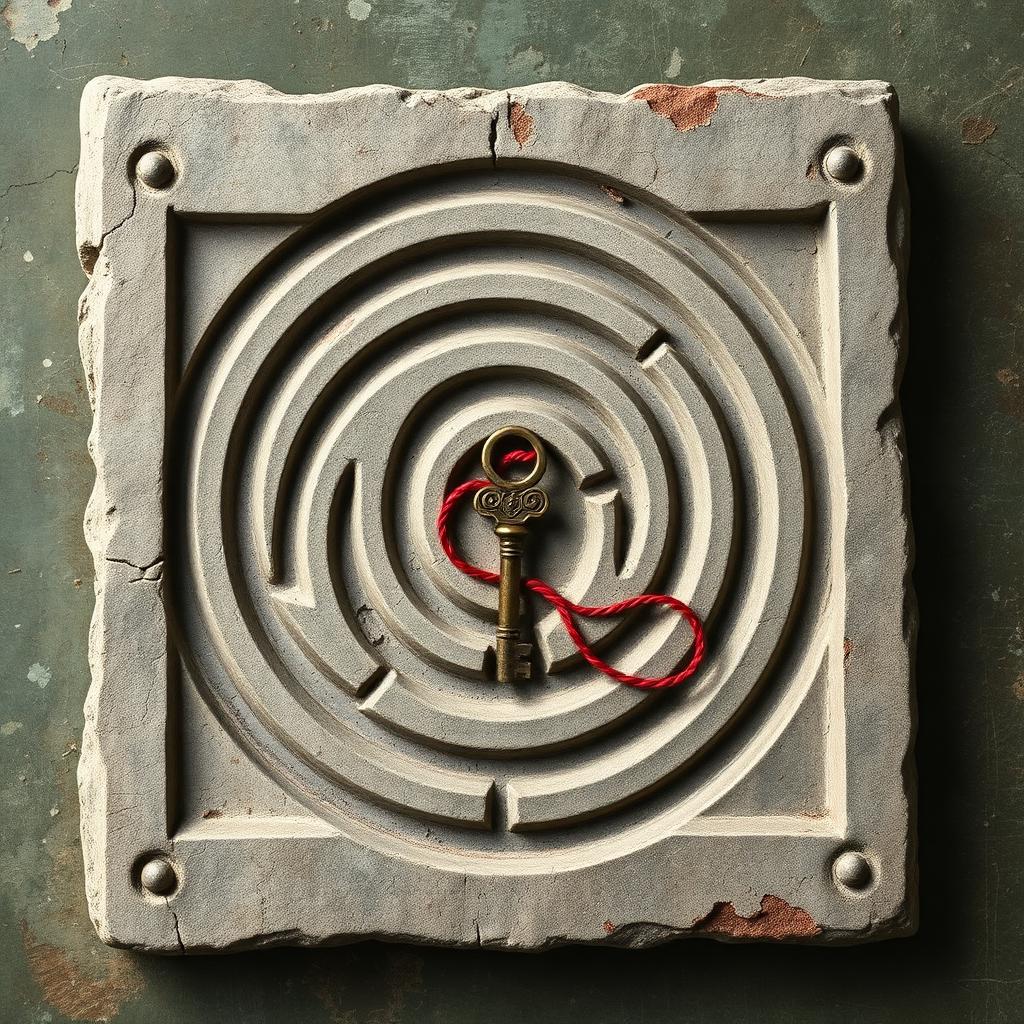
Thought Patterns
The Stories Hidden Inside Everyday Assumptions
Every assumption is a folded story. Open one carefully and you find a whole plot inside, complete with characters, stakes, and an old conclusion no one ever revisited.

If you stop a person mid-day and ask them why they just did the small thing they did, they usually cannot answer. Why they took the long way home, why they did not return that text, why they ordered the same coffee they have ordered for five years. The answer is almost always: I don't know, it's just what I do.
This is not laziness of reflection. It is how lives are built. Most of a life is made of small unexamined assumptions, each of which feels too small to deserve attention. The assumptions are not stupid. They are efficient. They free the mind for the few decisions it actually wants to make in a day.
But every now and then it is worth opening one. Because almost every assumption, when opened, turns out to contain a folded story. And the story, when you let it unfold, is much bigger than the assumption suggested.
The assumption as folded paper
Think of an assumption the way you might think of a folded letter. From the outside it is small, manageable, easy to carry. You can carry it around for years without noticing the weight.
Then one day, for whatever reason, you open it. Inside is a paragraph. Inside the paragraph is a scene. Inside the scene is a person, or a moment, or an old conclusion you reached when you were eleven and have not revisited since. The assumption, which felt like nothing, turns out to be a small archive.
This is what makes assumption-work so interesting. You do not have to look for the big stories. The big stories are already in the small assumptions, waiting to be unfolded.
Examples that may sound familiar
Consider the small assumption: I am not good at parties. Most people who carry this assumption have carried it for decades without ever opening it. If you open it, you usually find a scene. A specific evening, often in adolescence, in which something embarrassing happened in a social setting, and a young self, trying to make the embarrassment bearable, produced the conclusion. The conclusion became the assumption. The assumption shaped twenty years of declined invitations.
Or the small assumption: I am not someone who asks for help. Open it carefully and you find, almost always, an early environment in which asking for help produced one of three outcomes: it was refused, it was punished, or it was used later as evidence against you. The young self learned to stop asking. The adult, decades later, still does not ask, and still does not know that they once decided not to.
Or the small assumption: I am the kind of person who keeps the peace. Inside, very often, is a household in which someone else's anger was the controlling force of the climate. The young self learned that keeping the peace was survival. The adult is still keeping the peace, in workplaces and marriages where the original anger is nowhere to be found.
In each case the assumption is so smooth that it feels like simple self-knowledge. That's just how I am. And in each case, underneath, is a folded story that, if opened, would change the meaning of the assumption entirely.
Why the stories stay folded
The stories stay folded because unfolding them is uncomfortable. The folded assumption is portable. The unfolded story has weight. It has scenes, feelings, sometimes grief, sometimes anger, sometimes a recognition that something was unfair that nobody at the time was willing to name as unfair.
The mind is, on the whole, kind to itself. It does not unfold the stories on a normal day. It only unfolds them under specific conditions. A long therapy. A long illness. A long quiet stretch of life in which there is suddenly the bandwidth to feel what one has been carrying.
This is one reason midlife produces so much spontaneous unfolding. The structures of the first half of life have become solid enough that the mind feels it can afford, finally, to open some of the letters it has been carrying since childhood. Many midlife crises, on close inspection, are not crises. They are simply unfoldings. The person is, often for the first time, reading their own archive.
How to open one carefully
If you want to do this work without waiting for a crisis to do it for you, the method is not complicated. It is just unhurried.
You begin by noticing an assumption. Any small one will do. I always order this. I never speak first. I cannot relax until everything is tidied. I do not call my brother. The assumption should be one you have not really examined.
Then you ask, with curiosity rather than judgement: what story am I assuming when I do this? Not what is the rational justification. The rational justification is the cover. The story is underneath it. The story might begin with a sentence like, if I do not, then… or, people like me always… or, the last time I tried, what happened was…
You sit with whatever comes. You do not rush to conclusions, and you do not rush to dismantle the assumption. The point is not to win an argument with yourself. The point is to know what you have been believing.
Not all assumptions need to change
It is worth saying that opening an assumption does not obligate you to revise it. Some assumptions, when unfolded, turn out to be perfectly reasonable. The scene inside is one in which a young self learned something true, and the truth still applies. The assumption stays. You simply now know what is behind it.
This is its own form of freedom. The assumption that was unconscious is now conscious. You are no longer being driven by it. You are choosing it. And the choosing changes the texture of the act, even when the act remains the same.
Other assumptions, when unfolded, turn out to be obsolete. The scene inside took place a long time ago, the conditions have changed, the conclusion no longer fits. These assumptions, once seen, tend to loosen on their own. They were only holding because nobody had ever looked at them.
The cumulative effect
If you do this kind of small unfolding work, gently, over a long time, the cumulative effect is striking. The life starts to feel less automatic. The days are still made of small acts, but the small acts are no longer running on rails. There is a faint quality of presence underneath each of them. You are doing what you are doing because you are choosing to, not because a folded letter from 1994 is still issuing instructions.
This is what people sometimes mean when they say their inner life has become spacious. They have not added anything. They have simply unfolded a number of small assumptions, and the room their attention now lives in is larger because of it.
The stories were always inside the assumptions. You only had to open them.
The household of inherited assumptions
A great many of our assumptions did not originate with us. They were the household weather of the family we grew up in. People like us don't do that. We are not the kind of family that asks for help. In our house, money is something to be afraid of. These were said, often without being said, every day for the first eighteen years of a life. They were not assumptions of an individual. They were the local atmosphere.
Recognising these as household assumptions, rather than as personal truths, is a particular kind of liberation. You begin to notice that the rules you have been quietly living by were rules of a specific household, in a specific time, with a specific history. They are not laws of being human. They were the operating assumptions of one place. You are allowed, as an adult, to keep some of them and to set some of them down. They were not chosen by you. They do not have to be kept by you.
The assumptions of a relationship
Long relationships develop assumptions of their own. We do not talk about that. He is the one who handles the money. She is the one who plans the holidays. We are not the kind of couple who fights. Each of these assumptions started somewhere, and almost none of them were ever negotiated openly. They simply settled, the way silt settles.
Periodically, in any long relationship, it is useful to open one of these assumptions together. Not to dismantle it, but to look at it. To ask whether the assumption still serves both people, or whether it served them ten years ago and has been quietly outliving its usefulness since. Most of the brittleness in long relationships sits in unexamined assumptions. Most of the renewal sits in opening one or two of them, carefully, with the other person in the room.
This is small, and it is slow, and it is often the difference between a relationship that becomes stale and a relationship that continues to grow.
I post the short version of these on Instagram most days. Follow @mythradar on Instagram