Personal Mythology
What Is Personal Mythology?
Your life is not a list of unrelated events. A reflective essay on the hidden story running underneath your years - the recurring dreams, fears, questions and figures that quietly add up to a Personal Mythology.
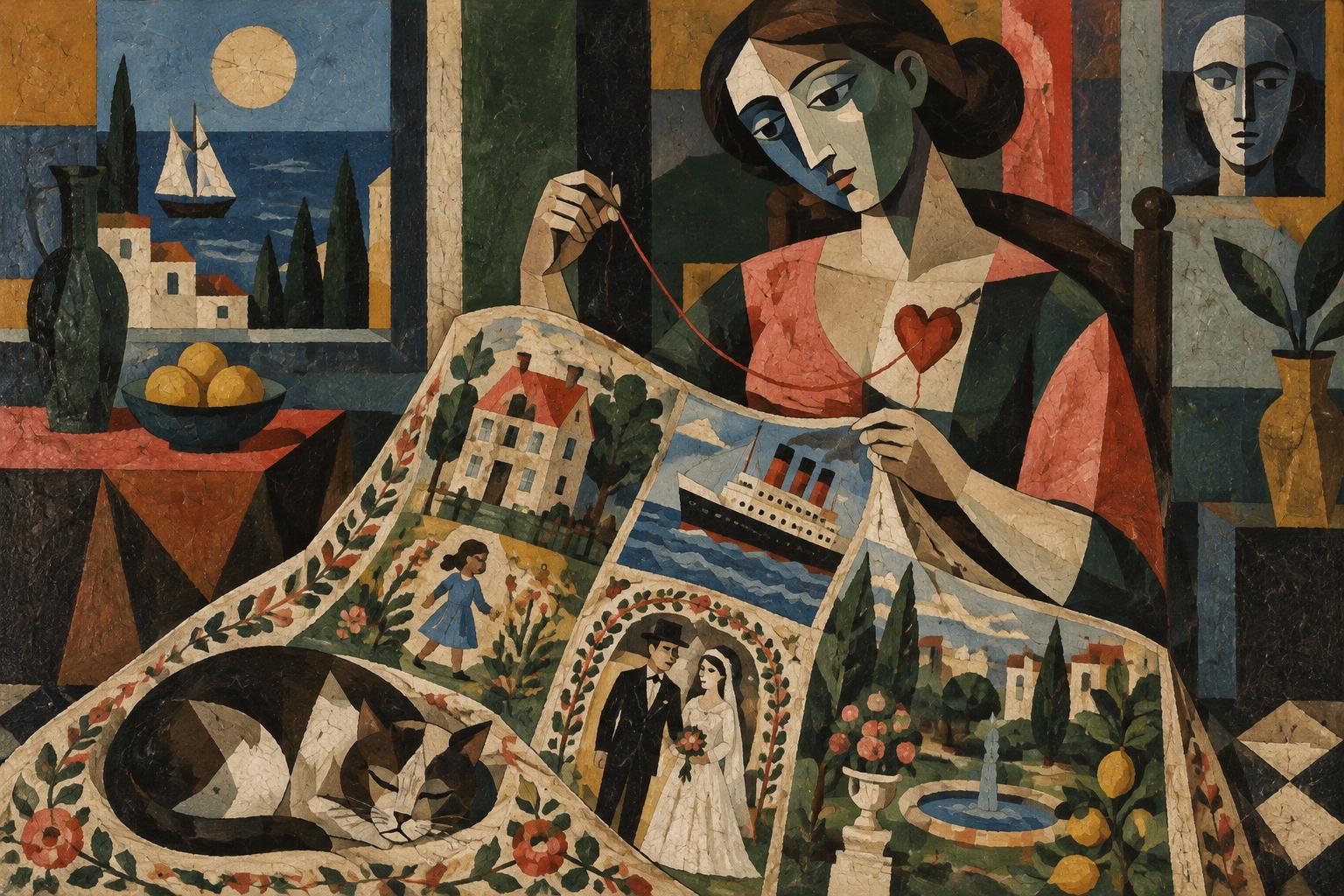
There is a quiet moment, sometimes very late at night, when a person looks back at the long stretch of their own life and feels a strange thing happen. The events stop looking like accidents. The people stop looking like strangers who happened to wander through. The repeated heartbreaks, the lucky meetings, the obsessions that would not leave, the questions that returned at every age in slightly different words - all of it begins, for a few seconds, to look like something that has been telling a story.
The feeling does not last. Within a minute or two, the practical mind comes back. The dishes are still in the sink. Tomorrow is still tomorrow. The momentary sense that your life has a shape is filed away with the other things you cannot quite explain. But it leaves a small, persistent residue. What if there is something here? What if all of this has been about something?
This essay is about that residue. It is about the suspicion, often quiet and almost never spoken aloud, that your life is not a list of unrelated incidents but a story trying, very patiently, to make itself known. The old word for the shape that story takes is mythology. Not in the sense of gods and heroes from a different century. In the sense of a deeper pattern that runs through one specific human life. Yours.
I want to talk about what it means to have a Personal Mythology, why it matters, and what changes when you begin to read your own.
The Feeling That There Must Be More To This
Almost every thoughtful person, at some point, develops a quiet suspicion that there is more going on in their life than they are being told. The world around them treats existence like a series of practical problems: get the job, find the partner, raise the child, save for the future, keep up with the news. But somewhere underneath all of that, a different question keeps tapping on the window. What is this actually about?
The question rarely arrives in clear words. It arrives as a feeling. A long drive home where you cannot remember what you were thinking, only that you were thinking something important. A sentence in a book that you re-read three times because it described you to yourself in a way you had never managed. A song that makes you cry and you do not entirely know why. A dream that lingers all morning. A chance meeting with someone who reminds you of a person you lost years ago, and suddenly the day has texture again.
These small experiences are easy to dismiss. The culture we live in does not have much patience for them. They do not fit into a calendar slot or a productivity metric. They are not, in the usual sense, doing anything. And yet for many people they are the most real moments of their week. The other moments are how they make a living. These moments are where they actually live.
The feeling that there must be more to this is not, I think, a delusion. It is not a failure to accept reality. It is the human capacity for meaning trying to do its work in a world that has temporarily forgotten what meaning is for. The capacity is older than any of us. It has been with our species longer than agriculture, longer than writing, longer than the cities we have built and rebuilt. It is the part of us that, sitting around an early fire, looked up at the stars and began to draw lines between them.
What we now call Personal Mythology starts in that exact place. It is the same instinct, turned inward. It is the part of you that suspects the events of your life are not random points of light, that there are lines between them, that something coherent emerges when you connect them in the right order.
The Story Beneath The Story
Most of us, when asked to describe our lives, give the outer story. We were born in such-and-such a place. We went to this school, then that one. We had jobs. We met people. Some stayed and some did not. There were a few harder seasons and a few brighter ones. We arrived here, where we are now, and we are doing roughly this with our days.
That outer story is true. It is also, almost always, the least interesting story we could tell about ourselves. It is the version that fits on a résumé or on the back of a book jacket. It is the version we offer to strangers because it is the version that requires the least of them.
Underneath that outer story, in every life I have ever taken seriously, there is a second one. It is not a list of events. It is a set of themes. Belonging and not belonging. The longing to be seen and the fear of being seen. A particular ache that came early and has never entirely left. A particular hope that came almost as early and has never entirely died. Three or four core questions that you keep asking, in different settings, with different people, in different decades. A handful of moments that, even now, you can recall with a clarity that the surrounding years do not have.
That second story is closer to the truth. It is the inner story. It does not move in straight lines. It does not honour the chronology of the outer story very neatly. A single conversation when you were nineteen might belong, in the inner story, beside something that happened to you at thirty-eight. A grandparent who died before you could really know them might play a larger role in the inner story than colleagues you have worked beside for years. The inner story has its own logic. Its arrangement is thematic, not temporal.
Personal Mythology is the name for the way that inner story organises itself over a lifetime. It is not a literary invention. It is something the psyche actually does, whether or not anyone is paying attention. The events of your life arrange themselves around certain images, certain wounds, certain longings, certain figures. Over time, those arrangements firm up into something with a recognisable shape - a story you have been living without consciously writing.
To say that you have a Personal Mythology is not to say that your life is a tidy fable with a moral at the end. It is closer to saying that, if you read your life the way you would read a long, serious novel - paying attention to recurring images, the way characters return, the questions the book seems to be asking even when no character is asking them - you would find a coherence that the outer story alone does not have.
That coherence is not invented. It is uncovered.
Why Certain Lessons Keep Returning
If you have lived for any length of time, you have probably noticed that certain lessons keep returning. The same kind of relationship trouble at twenty, thirty, forty, dressed in different clothes. The same fear arriving at the start of each new chapter. The same internal voice criticising you in roughly the same words your nine-year-old self would have recognised.
This is not, as we often fear, a sign that we have failed to learn. It is one of the clearest signs that a Personal Mythology is at work. Themes do not return because life is sloppy. They return because the inner story is still being written, and certain chapters have to be revisited from new vantage points before they can be properly understood.
I have come to think of recurring lessons as the curriculum of a particular life. Not a curriculum chosen by you, exactly. More like a curriculum that emerged from who you are and where you came from and what your particular soul appears to be working on. Some people return again and again to the question of trust. Some, to the question of voice. Some, to the question of belonging, or of self-worth, or of the limits of love, or of how to bear what cannot be changed. The themes are not infinite. There are only so many fundamental questions a human life can carry. But the way one specific person carries one or two of those questions, across decades, in their own circumstances, with their own people - that is unrepeatable. That is the mythology.
If you watch closely, the returning lessons are not identical. The first time you meet your particular theme, it is crude. It feels like a problem to be solved, an obstacle that does not belong. The second time, it has more nuance. By the fifth or sixth time, if you have been paying any kind of attention, you start to recognise it as it walks into the room. You stop trying to send it away. You start, slowly, to ask what it wants.
This is the moment a Personal Mythology becomes visible from the inside. It is the moment you realise the recurring theme is not the enemy of your life. It is the spine of it.
The Characters We Become
Every long life is populated by a small cast of inner characters. Not invented ones. Ones who live in you. The one who works too hard because they were rewarded for it early. The one who keeps the peace because conflict once meant danger. The one who runs at the first sign of being known too well. The one who can rise to almost any emergency and afterwards collapses for a week. The one who longs for something larger and is embarrassed by the size of their own longing.
These characters are not flaws. They are not personalities you can decide to swap. They are figures the psyche has built over the years, each one for an honest reason, each one carrying a piece of your history. In the language of older traditions, they would have been called archetypes - the universal figures (hero, child, sage, caregiver, rebel, shadow, magician) that show up in stories all over the world because they show up in lives all over the world.
Your Personal Mythology is partly the particular way these universal figures express themselves inside you. The hero in you does not look exactly like the hero in anyone else. Your caregiver has its own specific tenderness, formed by who needed you and who did not. Your rebel has its own particular cause, traceable to a moment, often early, when something in you decided that something else would not be tolerated.
To begin to see your Personal Mythology is, in part, to start meeting these inner characters with curiosity rather than judgement. Not to perform a costume change. To say, instead: so this is who I have been. This is who steps forward in this kind of situation. This is who I become when I am afraid. This is who I become when I am loved well.
When you can see your characters, you stop being run by them. You do not eliminate them - you cannot, and you would not want to. You learn which one is at the wheel right now. You learn which ones are quieter and need to be invited forward. You learn which ones rose up to protect a younger you and can now, gently, be allowed to rest. That kind of seeing is one of the most under-appreciated freedoms a person can grow into.
The Dreams That Refuse To Leave
Almost everyone has a handful of dreams they have not forgotten. Not the ordinary residue of a Tuesday night. The other kind. The dream that returns in different forms across years, with the same emotional weather. The dream that, on the morning after, leaves you walking around the kitchen as if something has been revealed and you cannot quite remember what. The dream you had at fifteen and can still describe at fifty.
The traditional view, which I think gets close, is that these dreams are the way the deeper layers of you speak. Not in argument. Not in advice. In image. The mind that runs your days speaks in sentences. The mind that runs your years speaks in pictures. A dream that refuses to leave is a picture the deeper mind has decided you needed to be given. The fact that you cannot quite decode it is not a sign that the message is faulty. It is a sign that the language is older and more patient than the one you usually think in.
In a Personal Mythology, the recurring dream is often a clue to the central theme. The dream of being lost in a building you almost recognise. The dream of trying to call out and finding you have no voice. The dream of arriving for an exam you never studied for. The dream of the person you loved and could not save, returning, gently, decades later, as if to say something you could not yet hear at the time. These are not random. They are the inner story drawing your attention to a thread you have been carrying without realising it.
You do not need to be a scholar to begin reading them. The single most useful question to ask, when an image will not leave you alone, is not "what does it mean?" - that question has a way of producing forced and clever answers. The better question is, what is this asking of me? Or, gentler still, what would I have to be willing to feel, if I let this image stand? Most recurring dreams are not coded messages. They are invitations to feel something more honestly than you have allowed yourself to.
The dreams that refuse to leave are usually the ones standing closest to the centre of your mythology. They have not stopped returning because the centre has not stopped being there. Once you start treating them as figures in a story rather than glitches in your sleep, your whole inner life takes on a different weight.
The Questions That Follow Us
Some questions follow a person through their entire life. They are not always dramatic. Am I too much? Will I be left? Is what I have to offer enough? Do I really belong here? What is my actual work in this life? Is there something I am refusing to see? Each of us tends to carry one or two such questions like a quiet current under everything we do.
The interesting thing about these questions is that they are almost never new. Look back and you will probably find some version of yours showing up at six, at sixteen, at twenty-six, at every age you have so far been. The wording changes. The context changes. The texture of the question, the precise place it pulls at, is uncannily consistent.
In a Personal Mythology, these are the organising questions. They are not symptoms. They are not problems to be solved and crossed off. They are the inquiries the deeper part of you came here to live with. Your life arranges itself, partly without your knowledge, around the conditions where those questions can be deepened, refined, occasionally answered, then re-asked at the next altitude.
Once you can name the question or two you have been carrying, a great deal of your behaviour starts to make a new kind of sense. The jobs you took. The relationships that stayed. The friendships that mattered most. The moments you felt most alive. The moments you felt most lost. You will probably find that the same question was being asked in all of them, sometimes hopefully, sometimes desperately, sometimes with a strange and surprising peace.
The questions that follow you are not a curse. They are, more often, the most personal thing about you. They are the shape your particular soul takes when it tries to understand its own life.
How A Life Reveals Its Themes
It is a peculiar fact about being a person that you cannot see the shape of your own life while you are inside it. The themes that organise it become legible only in retrospect, and even then only if you slow down enough to look.
This is partly why the second half of life so often feels different from the first. In the first half, you are mostly making the material - the relationships, the work, the choices, the mistakes, the unexpected turns. In the second half, more and more of your attention is drawn to what the material has been adding up to. Not because you have stopped living forward, but because the pattern has finally got enough data points to start being visible.
A life reveals its themes in several quiet ways. Through the moments you keep returning to in memory, often the smallest ones, often not the ones anyone else would have picked. Through the questions you find yourself drawn to in other people's stories - the parts of their lives that move you most are almost always a reflection of where your own story is most alive. Through the books, films, pieces of music, places, animals, landscapes that, across decades, have refused to lose their grip on you. Through the kinds of suffering that have most disturbed you and the kinds of beauty that have most undone you.
Themes also reveal themselves through what does not move you. There are tragedies the world considers terrible that, honestly, do not pierce you deeply, and others that the world barely notices that put you on the floor. There are kinds of success that should be exciting and feel oddly hollow, and small, almost invisible victories that feel disproportionately like home. These contrasts are clues. They tell you what your particular story is and is not about.
If you ever take the time to gather these clues - to write them down, even crudely; to notice them without trying to solve them - you will find, often to your surprise, that they do not contradict each other. They circle a few obvious centres. Those centres are the themes of your Personal Mythology. They have been there all along. You were simply busy enough to miss them.
Reading Your Own Mythology
Reading your own mythology is not a technique. It is closer to a long-term practice of attention. It does not require you to retreat from the world or take up unusual habits. It requires only a willingness to notice and a willingness to take what you notice seriously.
There are a few simple ways to begin. You can spend an afternoon listing, without editing, the events of your life that still feel charged - the moments that, when you remember them, still carry weather. Not the most important by any external standard. The ones that still feel alive. When you have twenty or thirty of them, ask whether anything links them. Almost always, two or three threads will appear. Those threads are part of your mythology.
You can pay attention to the figures in your dreams across a season, not to interpret each dream, but to notice who keeps showing up. The faceless pursuer. The lost child. The wise stranger. The house with the room you have never entered. Across a year, these figures begin to form a small repertory company. They are not random. They are players in your story.
You can notice the kinds of stories - novels, films, family stories, news stories - that affect you disproportionately. Why this one? Why does this particular pattern reach into you and turn the light on? Whatever the story is doing in you is something your own mythology is also doing. You are recognising yourself in it without consciously knowing why.
And you can listen, with new respect, to the questions that have followed you. Write them down. Notice their wording. Notice how they have changed, and how they have not. Notice when they get louder. Notice what makes them quieter. Treat them not as nuisances but as messengers.
None of this is fast. None of it produces a clean diagnosis. It is the slow work of becoming literate in the language your own life has been speaking all along. Over time, what was vague becomes specific. What felt like noise becomes signal. The story you have been living without writing comes, gradually, into focus.
What Changes When You Begin To See It
When you begin to read your Personal Mythology, the most surprising change is not that your life looks different. It is that you stand differently inside it.
You stop, slowly, treating your recurring difficulties as evidence that something is wrong with you. You start to recognise them as the shape of your particular work. You stop expecting yourself to be a person without your specific themes and start, more honestly, becoming a person who can carry those themes with more grace, more humour, more space.
You also stop trying to live somebody else's life. Most people, given the chance, will quietly try to model themselves on a story that is not theirs - the calm achiever, the fulfilled parent, the celebrated artist, the person whose certainty seems unbreakable. When you begin to see your own mythology, the borrowed stories lose their grip. Not because they were bad stories. Because they were not yours. They were, in some honest sense, wasting the life you actually have.
You become kinder to your past. Almost no one can read their own life as a coherent story for very long without forgiving large parts of it. The young version of you who made choices you would not make now becomes, in this light, someone who was doing their best with the chapter they were inside. The relationship that did not work, the years that felt like detours, the version of yourself you were ashamed of for a long time - they begin to belong to the whole arc rather than to sit outside it like errors.
You become more useful to other people. When you start to see that everyone is living some version of this same hidden process - a Personal Mythology trying, in their own way, to surface - you become less inclined to give advice and more inclined to listen. The first becomes less interesting. The second becomes the thing that actually matters.
And you become, in the simplest possible sense, more at home in your own life. Not because everything in it has improved. Because you have started to understand what it has been trying, all this time, to do.
A Final, Quiet Thought
I want to leave you not with a summary but with a small invitation.
Sometime in the next week, when you have a quiet half hour and nothing pressing in front of you, try this. Bring to mind the three or four moments from your life that, even now, you could describe in detail. They might be small. They might not be the ones that look important on paper. Sit with them. Notice what they share. Notice the way they pull on the same thread.
Then bring to mind the one or two questions you keep asking - the ones that follow you into different rooms of your life and refuse to settle. Place them beside the moments.
Then, if you can bear it, look at the people who have mattered most to you, including the ones who hurt you, including the ones you lost too soon. Place them beside the questions and the moments.
Sit there, for a few minutes, with all of it in the same room.
You will probably feel, very quietly, that something fits. That all of this has been about something. That your life, in its strange and unhurried way, has been telling you a story you have been almost ready to hear.
That is the beginning of reading your own mythology. There is no other entrance. You did not need one.
Perhaps your life has been trying to tell you something all along.
Perhaps you are finally close enough to begin to listen.
A place for the inner story
MythRadar exists for exactly this - the slow, honest work of noticing what your life has been trying to say. You can record the dreams that return, the thoughts that loop, the small daily moments that carry weight you cannot quite explain. Over time, MythRadar surfaces the threads running underneath: the recurring images, the archetypal figures, the questions and themes that keep weaving themselves through your days.
It is not a system to fix you. It is a quiet companion for the part of you that has always suspected there was a deeper story here, and would like, finally, somewhere to begin reading it.
Continue the thread
If this article resonated, three places to go next:
- Look up the symbols this touches in the Archetypal Dreams and Childhood Dreams entries.
- New here? What MythRadar is - why we treat dreams and recurring patterns as personal mythology rather than fortune-telling.
- Ready to map your own pattern? Begin your personal mythology profile.
Related reading
I post the short version of these on Instagram most days. Follow @mythradar on Instagram