CornerstoneCornerstone
Recurring Dreams
Some dreams are not content to visit just once. They return, knocking at the door of our sleep, as if waiting patiently for us to answer.
- pattern
- return
- unfinished
- insistence
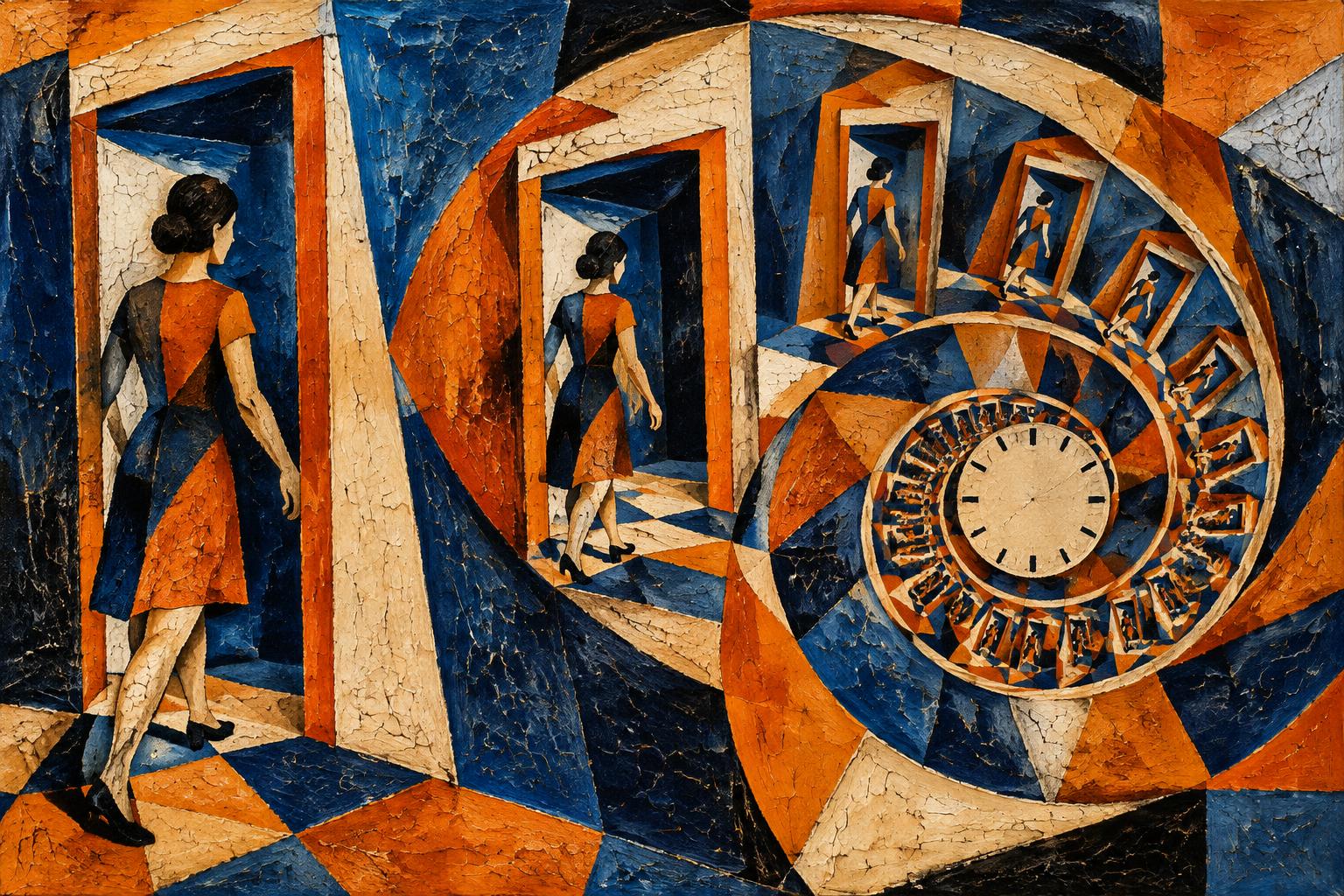
A recurring dream returns because the issue, feeling or pattern it represents has not yet been resolved in waking life. There is a strange familiarity in the opening scene of a dream like this, a quiet recognition that says, this one again. You know the landscape, the characters, the inevitable turn of events, because you have lived this story before, if only in the dark.
A single dream can be a passing whisper. A dream that returns again and again is asking for more. Its persistence suggests something has not yet been received. The relevant question is not what the dream is, but why it has chosen to be this insistent.
A recurring dream is less a broken record than a patient teacher. It often represents a question your waking mind has not learned to ask, or a feeling it has not found words for. It returns because the work is not finished.
Common interpretations
Recurring dreams tend to fall into a small number of families. Recognising which family yours belongs to is often more useful than analysing any single instance of it.
Being chased in the same way, night after night
A recurring chase almost always points to a persistent anxiety or a situation being avoided rather than confronted. See being chased dreams.
Returning to the same unfamiliar house
A house that reappears across many dreams, sometimes with new rooms each time, usually tracks a slow-developing part of your identity. See house dreams.
Losing teeth on repeat
This is one of the most reported recurring dreams and tends to cluster around periods of felt powerlessness or concern about appearance and self-presentation. See teeth falling out dreams.
Failing the same exam or arriving unprepared
A recurring exam dream usually reflects an ongoing sense of being evaluated or found wanting, often unrelated to school itself. See exam dreams.
The same person appearing again and again
A recurring figure, especially an ex-partner or a parent, often represents unfinished emotional business with what that person symbolises for you, not necessarily with them directly. See ex-partner dreams.
A recurring dream from childhood that has returned in adulthood
When an old childhood dream resurfaces years later, it is usually because a present situation echoes the emotional structure of whatever produced it originally.
A recurring nightmare with the same threatening figure
Repetition intensifies whatever a nightmare is already communicating. See nightmares and shadow dreams for how a persistent frightening figure is usually read.
Personal mythology
A dream symbol is never a fixed point; it is a vessel waiting to be filled by the dreamer’s own life. With a recurring dream, this becomes especially true, as the dream returns to a specific person, steeped in their specific world. Its meaning is not universal, but deeply, radically personal.
Consider a recurring dream of being unprepared for an exam. For a student facing finals, the dream may be a straightforward reflection of academic anxiety. But for a successful executive who has not been in a classroom for decades, the same dream could point toward something else entirely. It might touch upon a feeling of being tested in their career, a fear of being found out as an imposter, or the pressure to perform. The exam is not the point; the feeling of being unprepared is. The dream uses the language of the past to speak about the present.
Or take a recurring dream of a beautiful, unknown room discovered in one's own house. For someone feeling stagnated or creatively blocked, this dream might suggest untapped potential, a part of the self waiting to be explored. It offers a sense of hope and possibility. For another person, perhaps someone who feels their privacy is being invaded, the same dream of a strange room could be unsettling, pointing to a feeling that their inner life is not entirely their own, that there are unknown elements intruding upon their personal space.
The dream chooses its images from the archive of your life. The people, places, and feelings that populate it are drawn from your memories, your hopes, and your fears. Therefore, to understand its insistence, we are invited to look not at a dictionary of symbols, but at the living context of our own days. The dream is not speaking a foreign language; it is speaking your own forgotten dialect.
Questions worth asking
- What is the feeling that stays with you long after you have woken from this dream?
- If this dream were a messenger, what might its single, most important word be?
- When this dream first appeared in your life, what was happening for you?
- Is there a situation or pattern in your waking life that mirrors the central tension of the dream?
- What changes, even slightly, each time the dream returns?
- What might this dream be inviting you to look at that you have been turning away from?
- If you could speak to a character or element in the dream, what question would you ask?
What MythRadar would notice
A dream that comes back is a central theme in your personal mythology. It is not a glitch in the system, but a primary motif, a recurring chorus in the song of your psyche. Its return is not a sign of being stuck, necessarily, but an invitation to go deeper into a part of your own story that is still unfolding. Most of our lives are spent on the surface, moving from one task to the next. The recurring dream is a quiet, persistent tug from below, reminding us that there is a vast inner world that also requires our presence.
Think of it as a significant chapter in the book of you. A chapter that, for some reason, you are being asked to re-read. Perhaps you missed a crucial detail the first time. Perhaps the meaning changes as you, the reader, change over time. The dream does not return because it is static; it returns because you are dynamic. Your present circumstances shed new light on its old scenes. Its insistence is a form of intimacy, a way for a deeper part of you to maintain a conversation with the person you are becoming.
When a dream returns, it suggests that this particular constellation of images and feelings holds a key. Not a key to a universal secret, but a key to your own house. It is a prompt to pause and consider the foundational patterns of your life. The dream is simply a mirror, reflecting a pattern that exists just as much in the light of day as it does in the dark of night. The repetition is not the problem; the repetition is the clue.
Common questions
- Why do I keep having the same dream over and over?
- A recurring dream typically means the underlying issue, feeling or pattern it represents has not been resolved. It tends to stop once that material has been consciously acknowledged and addressed.
- Does a recurring dream mean something is seriously wrong?
- Not necessarily. It usually points to an ongoing, unresolved concern rather than a crisis, though very distressing recurring dreams are worth discussing with a therapist if they persist for a long time.
- Why did a childhood recurring dream suddenly come back as an adult?
- It usually returns because a present situation shares the emotional structure of whatever originally produced it, so the mind reaches for a familiar dream to describe a familiar feeling.
- How do I stop having a recurring dream?
- Identifying what the dream represents and addressing that issue directly in waking life is the most reliable route. The dream tends to lose its grip once its underlying message has been consciously recognised.
- Is it normal for a recurring dream to change slightly each time?
- Yes. Many recurring dreams keep the same core scenario while details evolve, which often tracks how your relationship to the underlying issue is gradually shifting.
Continue the exploration
Perhaps the first step with a recurring dream is not to rush toward an interpretation, but simply to sit with it. To welcome it as a familiar visitor, even if an unsettling one. When it arrives, take a moment to notice it fully. Write it down, not just the plot, but the atmosphere, the colors, the feelings that linger at the edges.
By holding it gently in your awareness, you begin a different kind of dialogue with it. You may find that over time, its form begins to shift, or your relationship to it changes. This quiet observation is the first step on a much larger journey - the journey into your own Personal Mythology, the unique and unfolding story of you.
Related symbols
From the Insights library
the next question
One entry is a symbol. Several, read together, are a pattern - and a pattern is the beginning of a personal mythology.