CornerstoneCornerstone
Nightmares
A nightmare feels like an attack, a violation of sleep's sanctuary. But what if its terrifying intensity is not a threat, but a measure of the importance of what we are being shown?
- fear
- shadow
- unfaced
- intensity
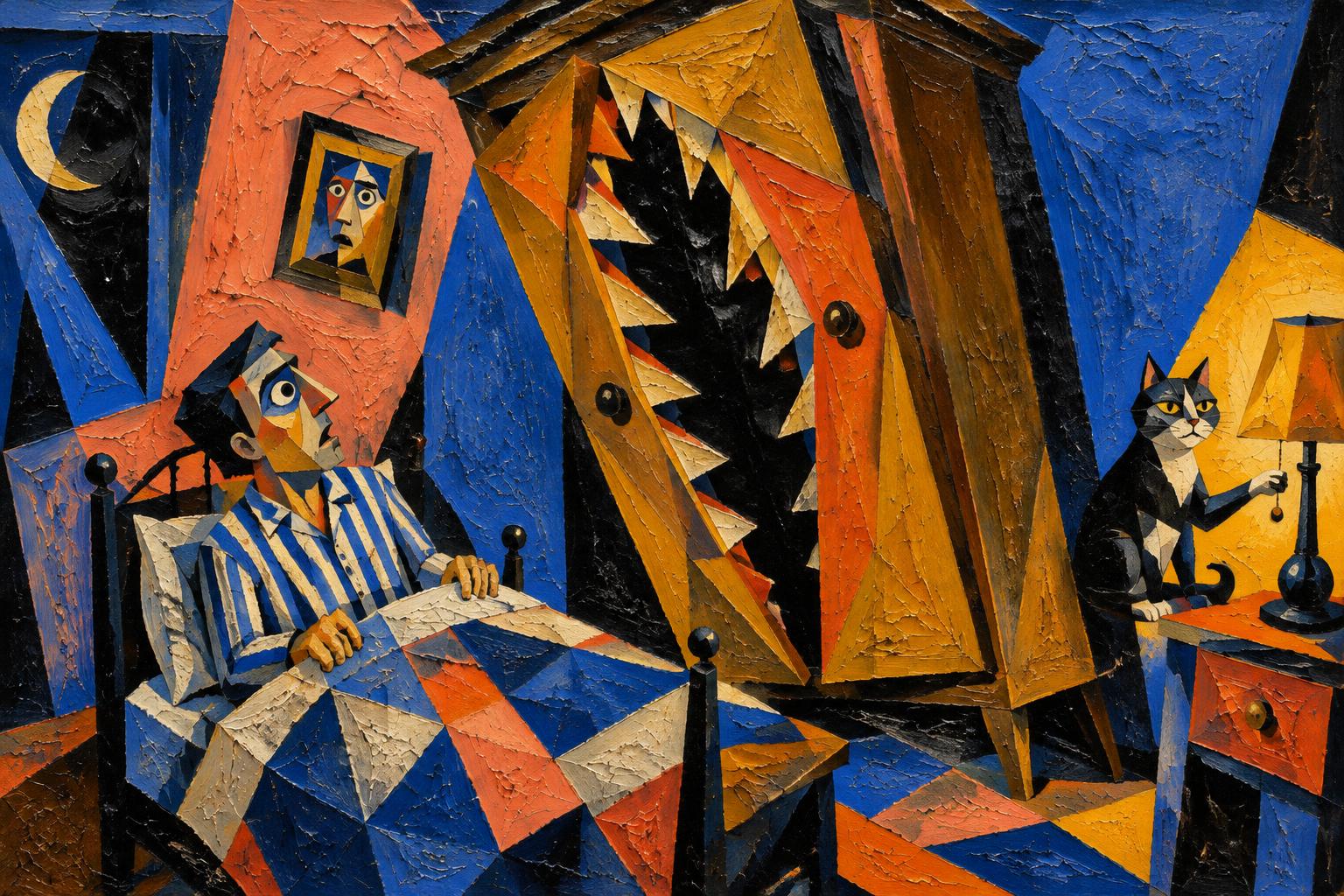
A nightmare is the mind processing fear, stress or a disowned part of yourself in its most direct and unfiltered form. When you wake from one, before any storyline is pieced together, what usually remains is a purely physical sensation: a racing heart, a cold sweat, a knot of dread that lingers in the dark.
The instinct is to push it away, turn on a light, think about anything else. That is a natural, protective response. But it is worth pausing before you do, because the first useful step is not to interpret the nightmare but to notice the state it has created in you, and ask why that intensity has arrived now.
The answer is usually not hidden in some obscure symbol. It tends to sit close to the surface, in whatever your waking life has been asking you to avoid.
Common interpretations
Nightmares cluster around a small number of recurring scenarios. Each points toward a different kind of pressure the mind is working to process.
Being chased by something you cannot see clearly
This is the most common nightmare there is, and it almost always describes avoidance: a problem, feeling or decision you are running from in waking life rather than confronting. See being chased dreams.
A monster or dark figure attacking you
Jung read the attacking figure in a nightmare as the shadow: a disowned part of yourself, gathering enough energy in the unconscious to demand recognition through the raw intensity of fear. See shadow dreams for the fuller pattern.
Falling with no landing
A fall that never resolves usually reflects a loss of control or support in waking life, financial, professional or emotional. See falling dreams.
Being unable to move, speak or scream
This paralysis nightmare is often linked to sleep paralysis, a physiological state where the body's normal sleep atonia persists briefly into waking. Psychologically it can also mirror a waking situation where you feel unable to act or be heard.
Drowning or being unable to breathe
Nightmares built around suffocation or drowning tend to describe being emotionally overwhelmed, feeling flooded faster than you can process. See drowning dreams.
Recurring nightmares with the same figure or setting
When the same nightmare returns repeatedly, the underlying issue it represents has usually not yet been addressed. See recurring dreams for how repetition itself carries meaning.
Nightmares after a frightening or traumatic event
Trauma-related nightmares often function as a grim rehearsal, the mind repeatedly simulating a threat response in an attempt to regain a sense of control over a memory of powerlessness.
Personal mythology
A dream dictionary can tell you that being chased suggests avoidance, or that falling points to a loss of control. This can be a useful starting point, but it can also be a distraction from the more important work. The power of a nightmare lies not in its universal symbolism, but in its fiercely personal language. The images and feelings that arise are drawn from the unique archive of your own life, your own history, your own heart.
Consider a dream of being pursued through a dark forest. For one person, this might be a direct echo of a recent, stressful work project, the relentless pursuer being a deadline they fear they cannot meet. For another, the same dream might stir the embers of a childhood fear of abandonment, the feeling of being small and alone in a world that feels vast and threatening. For a third person, an artist perhaps, the pursuer might be their own untapped potential, a creative force so immense that it feels terrifying to turn and face it. The dream is the same; the life it reflects is entirely different.
The key is to move from the generic to the specific. Who or what is the pursuer? Is it a faceless shadow, a wild animal, a person you know? A faceless entity might point toward an unformed anxiety, while a specific person may invite you to look more closely at that relationship. What is the texture of the fear itself? Is it the raw terror of annihilation, the suffocating panic of being trapped, or the shame-filled dread of being exposed? Each of these feelings points to a different corner of your inner world.
The landscape of the dream is also part of your personal myth. Are you running through the hallways of your childhood home? Through the sterile corridors of an office? Through a beautiful, yet threatening, natural landscape? These settings are not random. They are the emotional context for the drama. The nightmare is using the raw material of your life to construct a stage, and on that stage, it puts on a play about a feeling that your waking mind has been unable or unwilling to host.
Questions worth asking
- What feeling lingered in your body when you woke?
- If the 'monster' in the dream could speak, what one word might it say?
- Where in your waking life do you encounter a similar quality of intensity?
- Is there anything you feel you have been running from, or turning away from, recently?
- What part of you felt most vulnerable or helpless in the dream?
- If you could safely re-enter the dream as an observer, what would you notice that you missed?
- What strength or resource, if any, did you discover within yourself during the dream?
What MythRadar would notice
It is easy to think of a nightmare as a mistake, a glitch in the peaceful machinery of sleep. But in the landscape of a personal mythology, there are no mistakes. There are only stories. A nightmare is a story told with breathtaking intensity. It is a chapter that commands your full attention. When such a dream arrives, it may be a sign that a new theme is demanding to enter your life’s narrative, or that an old one can no longer be ignored.
We often speak of facing our fears, but perhaps a nightmare asks for something quieter than a confrontation. It may be an invitation to sit with a part of ourselves that we have exiled. The more we push a feeling or a truth away, the more distorted and monstrous it can become in the darkness of the unconscious. The nightmare is the return of the exile, knocking - or hammering - on the door. Often, what it wants is not to destroy us, but simply to be seen, to be heard, and to be allowed back into the wholeness of our being.
Sometimes, the scariest thing in the dream is not our weakness, but our un-claimed strength. That terrifying tidal wave could be the power of your own emotional life, long suppressed. That monster chasing you could be your own ferocious ambition, which you were taught to believe was unseemly. The intensity of the dream may be a perfect match for the intensity of the life force you are holding back. The nightmare, in this sense, is not a portent of doom, but a measure of your own potential, roaring to be let out.
Common questions
- Why do I have nightmares even when nothing bad is happening in my life?
- Nightmares can process low-level stress, disowned feelings, or old material the mind has not fully worked through, even when your circumstances currently look calm on the surface.
- What does a recurring nightmare mean?
- A nightmare that keeps returning usually means the underlying issue it represents has not been resolved. Once the feeling or situation is acknowledged and addressed, the nightmare typically fades.
- Are nightmares a sign of a mental health problem?
- Occasional nightmares are a normal part of dreaming and processing stress. Frequent, distressing nightmares that disrupt sleep or daily life are worth discussing with a doctor, since they can sometimes relate to anxiety, trauma or sleep disorders.
- Why can't I move or scream in a nightmare?
- This is often linked to sleep paralysis, a state where the body's natural sleep muscle inhibition briefly overlaps with waking awareness. It can also mirror a waking feeling of being unable to act or be heard.
- Do nightmares mean something bad is going to happen?
- No. Nightmares describe an internal state, usually fear, stress or an unacknowledged feeling, rather than predicting future events.
Continue the exploration
When a nightmare visits, an understandable reaction is to want to forget it. An alternative is to offer it a little curiosity. It can be a powerful practice to write the dream down, not to analyze or solve it, but simply to honor the fact that it happened. To give its strange images and potent feelings a little space to breathe on the page, outside the confines of your own head.
These intense dreams are often pivotal moments in our ongoing story. They are flares sent up from the deeper parts of ourselves, illuminating what we need to see. By paying them gentle, patient attention, we begin to learn the language of our own Personal Mythology. We become more intimate with the great, unfolding narrative of our own lives.
Related symbols
From the Insights library
the next question
One entry is a symbol. Several, read together, are a pattern - and a pattern is the beginning of a personal mythology.