Personal Growth
Why Personal Growth Often Feels Like Going In Circles
If your old fears keep returning, you are not failing. You are walking a spiral, not a circle - meeting the same lessons from a new height, with a slightly larger self.
There is a particular kind of tiredness that comes from years of trying to grow. Not the tiredness of effort, but the tiredness of suspicion. The quiet thought that arrives at the end of a long day, or in the middle of a familiar argument, or after the third or fourth journal entry about the same wound: I thought I was past this.
If you have ever read a stack of books on becoming a better version of yourself, sat with a therapist long enough to learn their tells, meditated through more mornings than you can count, and still felt the same old fear stir in your chest at the same old trigger - then you already know the feeling I am trying to name. It is not despair, exactly. It is something more humbling than that. It is the suspicion that, despite everything, you might not be moving at all.
I want to offer a different reading of that feeling. Not a more flattering one. A truer one. Because the story we have been told about personal growth - that it is a line, that progress is visible, that the past should be quietly retired once we have understood it - is not only wrong, it is unkind. It sets us up to interpret the most honest part of our development as failure.
What if the returning is the work? What if the circle you keep finding yourself in is not a circle at all?
Why Growth Rarely Feels Like Progress
The first thing to say plainly is that growth, while it is happening, almost never feels like growth. It feels like confusion. It feels like grief for a version of yourself you thought you had outgrown. It feels like the inconvenient resurfacing of a fear you had filed away under "handled." It often feels, in the moment, like regression.
This is not a flaw in you. It is a flaw in the metaphor we have inherited. We were handed a picture of change borrowed from school report cards and step counters: a clean line, ticking upward, measurable in weeks. We were told, by people who meant well, that if we did the inner work we would feel different - and that feeling different would be the proof. So when the old anxiety returns at three in the morning, or the old self-doubt walks into the new job, we conclude, reasonably, that we have failed.
But the people who study how human beings actually change - therapists, contemplatives, those who have walked beside the dying - tend to describe something stranger. They describe a process that loops. They describe insight as something that has to be earned more than once. They describe the self not as a project being completed, but as a landscape being mapped, slowly, by someone walking through it in different weather.
If you have ever returned to a piece of music you loved as a teenager and heard something in it you could not have heard then, you already understand. The song did not change. You did. And the only way you noticed you had changed was by returning.
Growth that feels like a steady climb is usually not growth. It is usually performance - the careful management of an image of progress. Real growth, the kind that rearranges the furniture inside you, is almost always disorienting while it is happening. You only recognise it afterwards, by the shape of what you no longer need.
There is a useful test for this. Think back to who you were five years ago. Not the version of you that you would post about, but the actual person, with their actual worries and small daily fears. Almost certainly there are things that consumed that person which barely register for you now. Not because you solved them in a single dramatic moment, but because, somewhere along the way, you became someone for whom those things were no longer the centre of the story. You probably could not name the day it happened. That is what growth looks like from the inside: invisible, until you turn around.
The Myth Of The Straight Line
Somewhere along the way, we agreed to a story about personal development that suits a productivity culture more than a human life. In that story, you identify a flaw, apply a technique, and graduate. You do the breathwork and the anger leaves. You read the book on attachment and the longing softens. You name the wound and it closes.
This story sells well because it is tidy. It is also, in my experience, almost never true. The flaws we are most ashamed of are rarely flaws at all - they are old strategies that once kept us safe. They do not leave when we understand them. They loosen. They lose their grip in some situations and keep it in others. They go quiet for a season and return, with perfect timing, when something tender is at stake again.
The straight line tells us that if a pattern returns, the work did not take. The truth is closer to this: the pattern returns because you have walked into a new room of your life where that pattern still has something to say. The work took. The room is new.
I think a great deal of what we call "stuckness" in adult life is really the collision between an honest psyche and a dishonest metaphor. The psyche is doing what psyches do - circling back, revisiting, asking the same question from a slightly different angle. The metaphor insists this means nothing is happening. So we add shame on top of the original difficulty, and the shame is what actually stops us moving.
It is worth noticing how recent the straight-line story is. For most of human history, people described the inner life in cycles. Seasons. Returns. Pilgrimages that ended where they began, in a person changed by the journey. The wisdom traditions, almost without exception, assume that you will pass through the same gates more than once and that this is the point, not a problem with the gates. It is only in the last century or so, with the rise of self-improvement as a marketable product, that we have started measuring inner change with the same tools we use for productivity metrics. We should not be surprised that the measurements feel false. They were borrowed from somewhere else.
If a pattern returns, it is not always evidence that you have failed to learn. It is sometimes evidence that there is more of the lesson left to receive.
Why Old Patterns Return
Old patterns return for the same reason old songs do. They are stitched into the structure of a self that took years to build. They were, once, the most intelligent response available to a smaller version of you who had fewer resources and less safety. They are not enemies. They are former protectors who do not yet know they can rest.
When a pattern returns, it almost always returns in a slightly different costume. The same fear of being too much, but this time in a relationship that actually has the capacity to hold you. The same instinct to disappear, but this time in a job where being seen would be safe. The same defensive sharpness, but this time aimed at someone who is genuinely on your side. The costume is what makes it confusing. The body underneath is familiar.
The reason it returns now - and not last year, when you thought you had finished with it - is usually that something in your life has finally become safe enough, or important enough, or close enough, for the pattern to be relevant again. The unconscious is not careless about its timing. It brings up old material when there is finally a chance to do something different with it.
This is one of the kindest things to know about yourself. The returning fear is not proof that you have not grown. It is often proof that you have grown enough to face it in a context that actually matters.
A man who avoided closeness all his life will not feel his avoidance most acutely when he is alone. He will feel it most acutely the first time someone stays. A woman who learned to be small will not notice the smallness in rooms where it is rewarded. She will notice it the first time she is offered a room with enough space for her actual size. The pattern shows up where there is finally something at stake. That is not regression. That is contact.
There is a related thing worth saying. Sometimes a pattern returns not because you are entering new territory, but because you are tired. Grief, illness, a hard season at work, a difficult month with a parent - all of these temporarily shrink the bandwidth available to your more recent, more spacious self. The older patterns step in because they are well-rehearsed. They run on less. This is not a sign that the new self was a fiction. It is a sign that the new self requires energy you do not currently have. Treat the return with the same generosity you would offer a friend who reverted to old coping during a hard week. Notice it. Do not crucify yourself for it. The newer self comes back when there is room.
The Spiral Instead Of The Circle
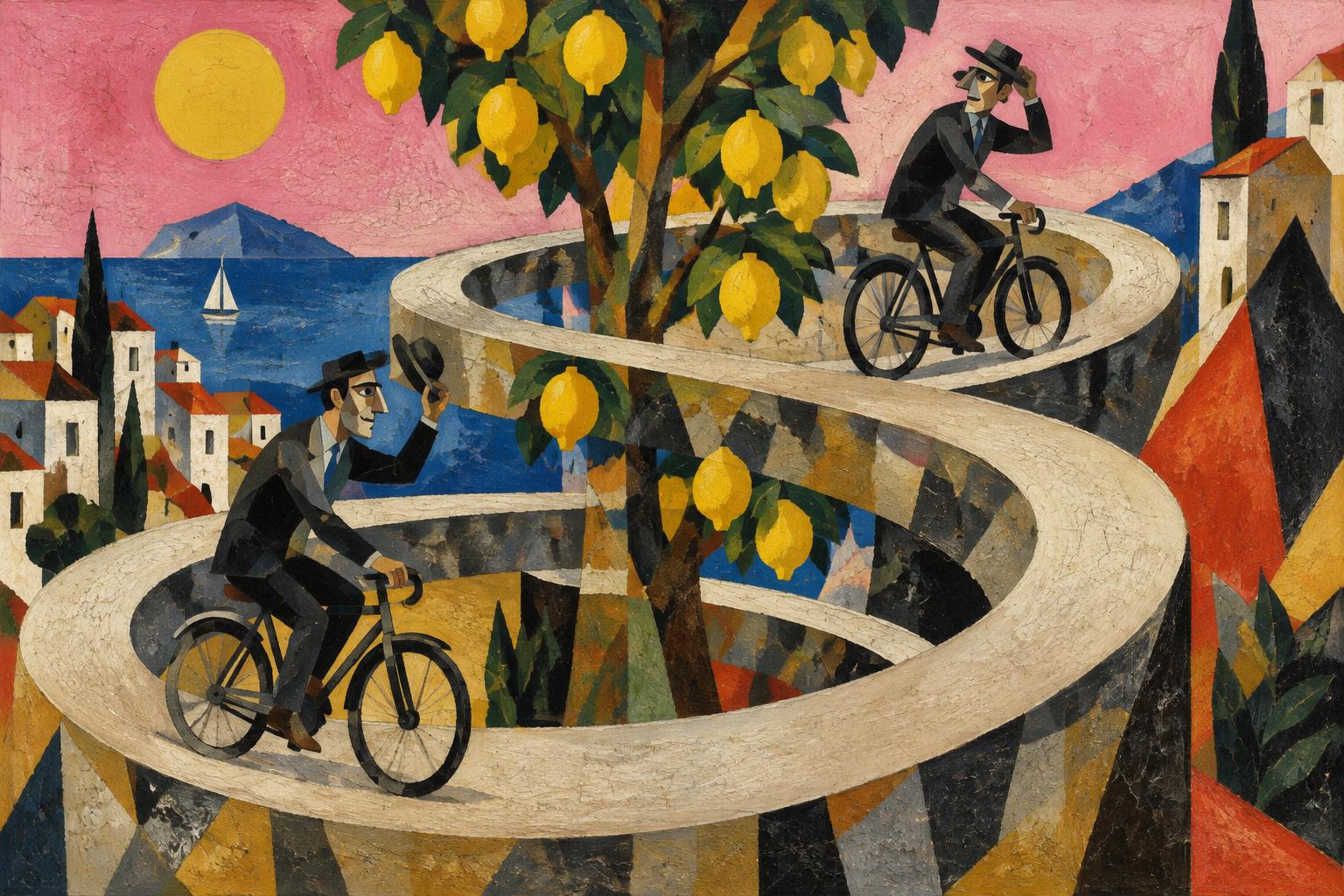
If you take only one image from this essay, take this one. You are not walking in a circle. You are walking in a spiral.
From above, a spiral and a circle look almost identical. You pass through the same compass points. You revisit the same themes. You meet, again and again, the same handful of fears that have always belonged to you. If you only ever looked down at your feet, you would swear you were going nowhere.
But a spiral has a dimension a circle does not. With each pass, you are at a different height. The view changes. The light falls differently on the same landmarks. The fear you meet on this turn is wearing the same face, but you are meeting it from a vantage point that did not exist the last time you stood here.
This is why so many people who have done long, serious inner work describe their lives as deepening rather than improving. They are not collecting new selves. They are revisiting the same self at finer and finer resolutions. The grief they thought they had finished with at twenty-five returns at thirty-five with a different texture, because the person grieving has more capacity to feel it. The shame they reckoned with in their first therapy returns in their fourth, because there is a layer underneath the layer they could reach before.
None of this is failure. It is the only way a human being actually changes. We do not graduate from our material. We become more skilful, more spacious, more honest with it. The spiral is not a punishment for not learning. It is the architecture of learning itself.
When you next catch yourself thinking, I cannot believe I am here again, try the smallest possible adjustment. Try: I cannot believe I can be here again with this much more of me present. It is the same sentence with the floor raised.
The spiral also explains why our old teachers stop being enough and why we sometimes outgrow the books that once saved us. The teaching did not become wrong. You moved up one turn. From the new height, the teaching needs to be re-translated. The phrases that cracked you open at twenty-two will not necessarily reach you at thirty-six, not because they were shallow but because you are now standing in a deeper place that needs deeper language. This is also part of the work: noticing when you have outgrown a map, and being willing to draw the next one.
What Repeating Lessons Are Really Showing You
If a lesson keeps returning, it is worth asking what it is actually trying to teach. Not at the level of slogan - "love yourself," "set boundaries," "trust the process" - but at the level of the specific, lived, often inconvenient instruction underneath.
Repeating lessons tend to refine themselves over time. The first time the lesson arrives, it may sound like: stop abandoning yourself for other people. The second time, after you have done a great deal of work on that, it may sound more like: notice the precise moment in a conversation when you start to disappear, and stay one breath longer. The third time, after years, it may have become almost wordless: a small, embodied recognition that you are about to leave yourself, and the choice to stay.
What looks from the outside like the same lesson is, on the inside, a series of increasingly specific instructions. The crude version had to come first. The fine version could not have been heard back then. The repetition is the curriculum.
It can help, when an old theme returns, to ask three questions in order. What is different this time? Almost always something is - the context, the people, the stakes, the resource you have available. What can I notice now that I could not notice before? Often something subtle: a body signal, a tell in your own voice, a half-second of choice you used to miss. What is the smallest honest response available to me here? Not the heroic response. The honest one. The lessons that keep returning are usually not asking for transformation. They are asking for a slightly more accurate move than the one you made last time.
If you keep records of any kind - a journal, voice notes, a folder of half-finished essays you never sent - go back six months and read what you wrote about the thing that is troubling you now. You will probably find one of two things. Either you were writing about the same theme in cruder language, which means the repetition is doing its work, or you were writing about it with insight you have temporarily lost touch with, which means your future self is closer than you think. Either way, the returning lesson stops feeling like a wall and starts feeling like a conversation that has been going on for some time.
The Difference Between Repetition And Regression
One of the most useful distinctions I have ever learned to make is the difference between repetition and regression. They feel similar from the inside. They are not the same.
Regression is when you collapse into an old pattern and lose the perspective you had gained. The pattern runs you. There is no observer. You are inside the weather. Afterwards, when you come back to yourself, you can see clearly that something took you over and you did not notice while it was happening.
Repetition is when an old pattern arrives, and some part of you - even a small part, even a part you do not entirely trust - notices it arriving. You may still act it out. You may not be able to stop it the first few times. But something in you is watching. Something is keeping notes. Something knows the shape of this weather because it has lived through it before.
That watching part is the actual measure of growth. It is not whether the pattern stopped. It is whether the pattern is now visible while it happens. Visibility is the slow, real change. Behaviour follows visibility, eventually, and usually later than we would like.
If you can say, even quietly, I see this pattern showing up again, you are no longer purely inside it. The pattern has become an object in your field of awareness, instead of the whole field. That is not nothing. That is the precise place where new options begin to grow.
Regression looks like: I am that person again, and I always will be. Repetition, honestly examined, looks like: I recognise this. I have been here. I am not exactly who I was the last time I stood here. The second sentence is the one that contains a future.
It is worth being gentle with yourself about the gap between seeing a pattern and stopping it. They are different skills. Seeing usually comes first by months, sometimes by years. For a long time, you will catch the pattern only after it has already played out. Then, eventually, in the middle of it. Then, on the better days, just before it begins. None of these stages is a failure of the previous one. They are the natural order of how awareness becomes choice.
How Perspective Changes Everything
There is an old idea, found in many traditions, that wisdom is not the accumulation of new knowledge but the deepening of relationship with what you already know. The facts of your life do not change very much, in the end. The way you stand in relation to them does.
This is why two people can describe identical childhoods and arrive at completely different lives. It is not the events. It is the angle from which the events are held. And the angle is not fixed. It is one of the few things that genuinely can keep changing, for as long as you are willing to keep looking.
When you revisit an old wound from a new height on the spiral, what changes is not the wound. It is your relationship to the person who received it. The first time, you might revisit it as the child it happened to. The second time, as the adult who is trying to make sense of it. The third time, perhaps, as someone who can sit beside that child without needing them to be anyone other than who they were. Each pass is doing real work, even though, from the outside, it looks like you are talking about the same thing again.
The work of perspective is quiet. It rarely produces a story you can tell at dinner. It produces, instead, a slow shift in the temperature of your inner life. The things that used to burn you start to warm you. The memories that used to seize your chest start to sit in your hands. You do not stop having a past. You stop being run by it.
If you find yourself returning, again, to a season of your life that you thought you had understood, try to receive the return as an invitation rather than a verdict. Something in you is offering to re-meet that season from a place you could not stand in before. The fact that you are willing to look again is the proof that you can.
Becoming The Person Who Can Hold More Truth
The real measure of inner work, I have come to believe, is not how much you have healed. It is how much truth you can hold without needing to look away. About yourself. About the people you love. About the parts of your life that did not go the way you hoped.
This capacity grows slowly, in layers, in spirals. You can only ever hold the truth your current self has the strength for. When you have grown enough to hold more, more is offered. That is often why old material returns. Not because you failed to deal with it. Because you have finally become someone who can deal with more of it.
The fear you meet at thirty is not the fear you met at twenty, even if it wears the same face. The thirty-year-old you has a wider chest. There is more room inside you for the fear to exist without taking over. That is what growth actually builds: not the absence of difficult inner weather, but a larger interior in which the weather can pass through.
I think this is the quiet promise that the straight-line story misses entirely. You do not become a person without fear, without grief, without the old familiar ache. You become a person who can carry those things and still walk forward. You become roomier. You become more honest. You become harder to knock over, not because the wind has stopped, but because you have grown roots that the younger you did not have time to grow.
This is unglamorous work. It does not photograph well. It does not make a good before-and-after. But it is the work that, in the end, actually changes a life. And it is almost always being done in the moments when you feel, most acutely, that nothing is changing at all.
It is worth saying, too, that holding more truth is not the same as confessing more or analysing more. Sometimes the truth you have grown to hold is small and gentle. That hurt more than I let myself admit at the time. I was doing the best I could with what I had. That person never had the capacity to give me what I needed, and it was not because of me. These sentences sound modest. They are not. Being able to stand inside them without flinching is the work of years. Each one is a turn of the spiral that ends with a self large enough to hold what is actually true.
A Final, Quiet Reflection
If you are reading this because you are tired - because you have done so much work and the old fears are back and you do not understand why - I want to leave you with the smallest possible reframe.
You are not failing because the patterns returned. The patterns returned because you have built a life that is finally close enough to the bone for them to be relevant again. They are not asking you to start over. They are asking you to meet them with the slightly larger self you have, in fact, become.
The fact that you can name the pattern now, even as it runs, is not nothing. The fact that you can feel the old fear and still, eventually, find your way back to yourself, is not nothing. The fact that you have kept showing up - to the work, to the relationships, to the page, to your own mind - is the entire substance of growth. There is no other thing. There is only this returning, more honestly each time.
Perhaps you are not going in circles.
Perhaps you are moving deeper.
A companion for the spiral
If this essay has named something you have been carrying quietly, MythRadar exists to walk beside you as you keep noticing. It is built for exactly this kind of work - the slow, layered kind, where the same themes return wearing new clothes and you need somewhere to track what is actually changing underneath.
You can record the dreams that keep visiting you, the thoughts that loop, the small daily moments that suddenly feel charged with meaning. Over time, MythRadar surfaces the patterns hiding in plain sight: the recurring images, the archetypal weather, the themes your life has been rehearsing for years. It does not try to fix you. It helps you read the cartography you have already been drawing.
If you would like a companion for the next turn of the spiral, you are welcome here.
Continue the thread
If this article resonated, three places to go next:
- Look up the symbols this touches in the Recurring Dreams and Dreams About Change entries.
- New here? What MythRadar is - why we treat dreams and recurring patterns as personal mythology rather than fortune-telling.
- Ready to map your own pattern? Begin your personal mythology profile.
I post the short version of these on Instagram most days. Follow @mythradar on Instagram