CornerstoneCornerstone
Shadow Dreams
To dream of a shadow is not always to dream of darkness. It might be a quiet invitation to encounter a part of ourselves we have yet to truly meet.
- unowned
- disowned
- integration
- encounter
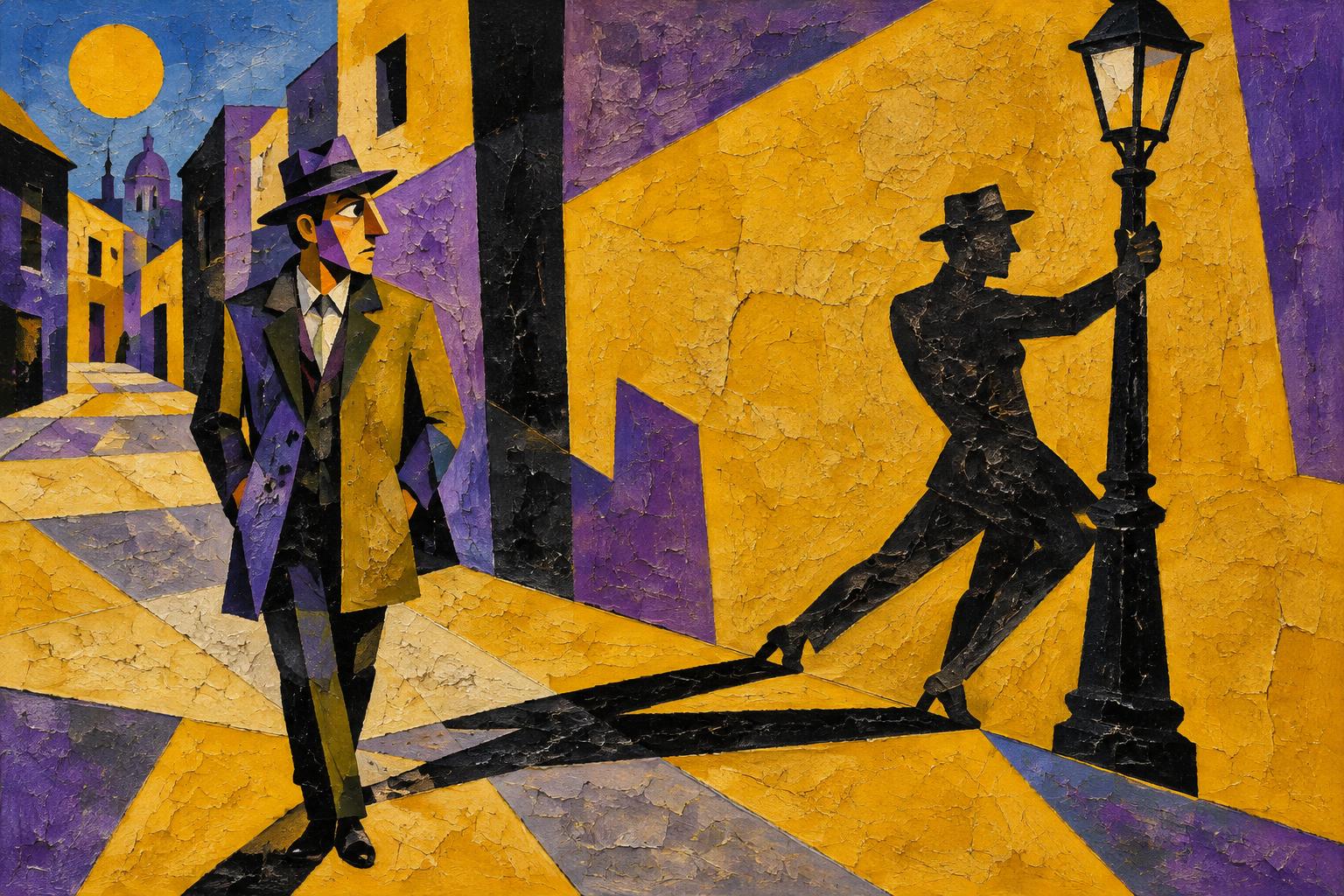
A shadow dream features a dark, threatening or pursuing figure that usually represents a part of yourself you have disowned rather than an external threat. We walk with our shadows every day, extensions of our own form we rarely turn to look at. In a dream, that companion can step out of the background and take on a life of its own.
It may pursue you down a corridor, stand silently in a familiar room, or wear the face of a stranger or an enemy. When it does, the question is not simply what the figure means. It is why this part of your story is being cast in silhouette now, waiting for you to turn and face it.
Carl Jung named this figure the shadow: not an external evil, but the sum of what your conscious personality has judged unacceptable, inconvenient or unsafe to express, including qualities that are not negative at all.
Common interpretations
The shadow rarely announces itself plainly. It tends to appear disguised as a threat, which is exactly what makes it easy to misread as an attack rather than a message.
A dark figure chasing you
Being pursued by a shadow figure often mirrors a waking habit of running from an uncomfortable truth about yourself rather than confronting it. See being chased dreams.
A stranger who feels menacing for no clear reason
An unnamed figure who unsettles you without an obvious cause is often carrying a quality you have not consciously claimed, sometimes something as unexpected as ambition, anger or desire. See stranger dreams.
Fighting an unknown enemy
A struggle against a faceless opponent frequently dramatises an inner conflict between your conscious self-image and a quality it has rejected. See fighting dreams.
A double or distorted version of yourself
Seeing your own face on a threatening figure is one of the clearest shadow images there is, since it makes the disowned quality's origin explicit. This often surfaces alongside mirror dreams.
A shadow figure that turns out to help you
When the frightening figure is approached rather than fled, dreamers sometimes find it becomes an ally. This shift often marks real progress toward integrating whatever quality it represents.
A shadow appearing during a nightmare
The most intense shadow encounters tend to arrive as full nightmares, since the material being surfaced has usually been suppressed for some time. See nightmares.
A shadow figure of the opposite gender to you
Jung distinguished this from the anima or animus, the personified opposite-gender aspect of the psyche, though in practice the two figures can overlap and both point toward disowned or undeveloped qualities.
Personal mythology
While frameworks like Jung’s can offer a valuable map, the territory of your dream is uniquely your own. The meaning of a shadow figure is not found in a book, but in the context of your personal story. The same image can hold vastly different resonance for different people. For one person, a dark, silent figure in the distance might evoke a feeling of profound loneliness and abandonment, perhaps connected to early life experiences. For another, that same silent figure could represent a quiet, powerful strength they have not yet learned to claim.
Consider the specific feeling the dream leaves with you. Is it pure terror? Or is there a strange flicker of recognition, even fascination? A disciplined executive who dreams of being chased by a homeless drifter may, on the surface, feel fear of chaos and failure. But a deeper look might reveal that the drifter embodies a freedom and lack of responsibility that the executive secretly craves. The shadow isn't just the 'bad stuff'; it's often the 'other stuff', the parts of the full spectrum of human experience we have edited out of our personal narrative.
The character of the shadow in your dream is a clue. Who is this figure? A rival from your past? An archetypal villain? A distorted version of yourself in a mirror? If the figure is a rival, it might point not only to your unresolved conflict with that person, but to the qualities within them that you have disowned in yourself. Perhaps their assertiveness is something you’ve labeled as 'aggressive' and repressed, and now your psyche is suggesting it’s a source of energy you need.
Ultimately, a shadow dream invites you to become a student of your own mythology. What are the rules of the world you’ve built for yourself? What qualities are heroic, and which are villainous? The shadow’s appearance often signals that this personal mythology has become too rigid, too narrow. It arrives to challenge the story, to complicate the characters, and to suggest that the real path to wholeness lies not in defeating the villain, but in understanding what part of you it represents.
Questions worth asking
- What feeling does this dream figure leave you with when you wake?
- If you were to turn and face this figure instead of running, what might happen?
- Is there any quality in this shadow figure, even a negative one, that feels strangely familiar?
- What part of your own story feels unwritten, unlived, or unspoken?
- Who in your life have you had to become, and what parts of yourself were left behind?
- If this figure could speak, what is the one thing it might say that you don't dare to say yourself?
- Where in your waking life do you feel pursued or haunted by something you cannot quite name?
What MythRadar would notice
There is a particular courage required even to remember a dream like this, let alone to hold it gently and inquire into its nature. These encounters can feel so visceral, so real, that our instinct is to push them away, to dismiss them as 'just a nightmare'. But what if it is something more? What if it is a message from the deepest, most honest part of you?
The appearance of the shadow in a dream could be seen as a sign of health, a signal that the psyche is ready for a new level of maturity. It suggests that the container of your conscious life has become too small for the totality of who you are. The energy of the unlived life is knocking at the door. It is often a difficult and uncomfortable messenger, but the gift it brings is the possibility of becoming more whole. The shadow holds our vitality. The parts of us we banish do not die; they simply operate in exile, often working against us in unseen ways.
To encounter the shadow in a dream is to be invited into a dialogue with the forgotten self. It is a slow, patient work. It is not about a single interpretation that 'solves' the dream. It is about beginning a relationship with this hidden aspect of your own being. This is a recurring theme in personal mythology: the hero must often go into the underworld or face a fearsome dragon not to slay it, but to retrieve a lost treasure. In this story, the treasure may well be a part of yourself.
Common questions
- What does it mean to dream about a dark, threatening figure?
- In a psychological reading, a dark or threatening figure usually represents a disowned part of yourself, a quality your conscious personality has judged unacceptable rather than an external danger.
- Is the shadow in a dream always something negative?
- No. The shadow holds whatever has been rejected by your conscious self-image, which can include buried creativity, assertiveness or desire just as easily as anger or cruelty.
- Why does the shadow figure often look like a stranger or enemy?
- Disguising the disowned quality as someone unfamiliar or threatening lets the dream present it without immediately identifying it as part of you, which is usually easier for the psyche to tolerate.
- What should I do if I keep dreaming about being chased by a shadow figure?
- Try turning to face the figure within the dream if you can, and in waking life consider what quality you have most firmly rejected in yourself. Recurring shadow chases usually ease once that quality is acknowledged.
- Is a shadow dream the same as a nightmare?
- Not always. Shadow dreams can be unsettling without being full nightmares, though the most intense shadow material often does surface through nightmare-level fear.
Continue the exploration
A dream of this nature is significant. It asks for our attention. Perhaps the first step is simply to notice it without judgment. To write it down, capturing the feeling, the atmosphere, the precise details of the encounter. Hold it as you would a mysterious object found on a long walk.
Notice if it returns, if the figure changes, if your reaction to it in the dream begins to shift. This is not about finding an immediate answer, but about being open to the question. This is the beginning of a deeper look into your own personal mythology, a journey into the rich and complex landscape of you.
If this figure keeps returning, the shadow work prompts give you a way to write toward what it is carrying.
Related symbols
From the Insights library
the next question
One entry is a symbol. Several, read together, are a pattern - and a pattern is the beginning of a personal mythology.